
What you can trade
Six categories, every major prediction-market contract type. Markets group under events so you can compare related contracts side-by-side.
Politics
Elections, primaries, confirmations, policy outcomes, geopolitical events. Yes/No and scalar (vote share, seat count).

Crypto
Price-target contracts, ETF approvals, protocol milestones, token launches, network metrics.

Sports
Game outcomes, season-long props, championship odds, head-to-heads, futures.

Culture
Awards, box-office numbers, music charts, viral moments, cultural milestones.

Economics
CPI prints, Fed decisions, GDP, unemployment, earnings, macro releases.

Tech & business
Product launches, IPOs, M&A, regulatory decisions, model benchmarks, company milestones.
Events vs. markets
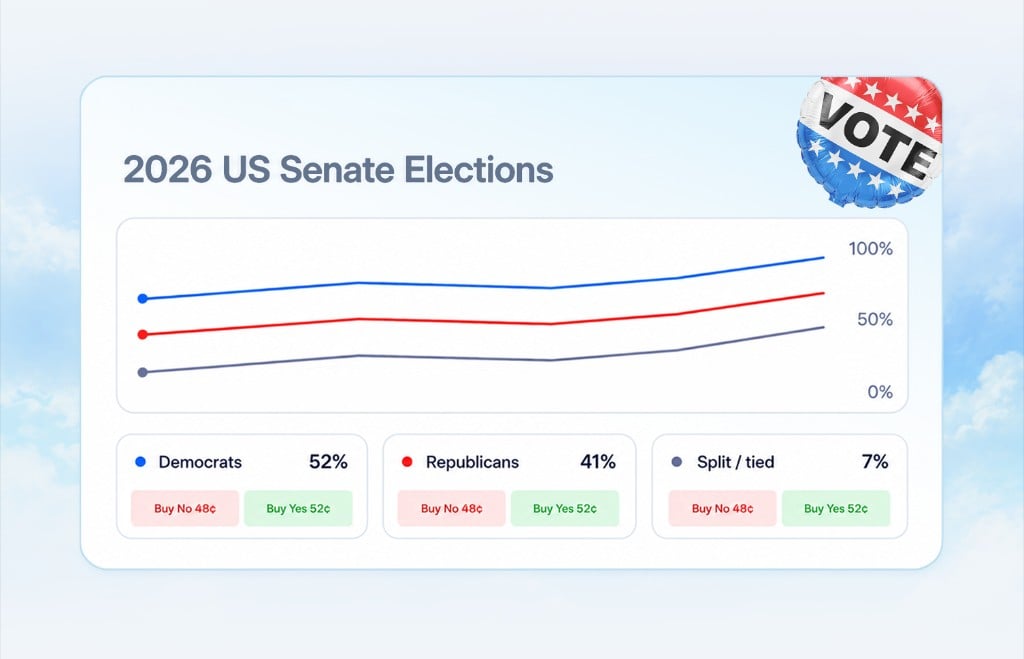
Pear groups related contracts under a parent event.- An event is a real-world thing that’s about to be resolved (e.g. “2026 US Senate elections”).
- A market is a specific contract under that event (e.g. “Will Democrats hold the Pennsylvania Senate seat?”).
How prices work
Every market on Pear quotes a probability between 0¢ and 100¢, which is also the cost per share.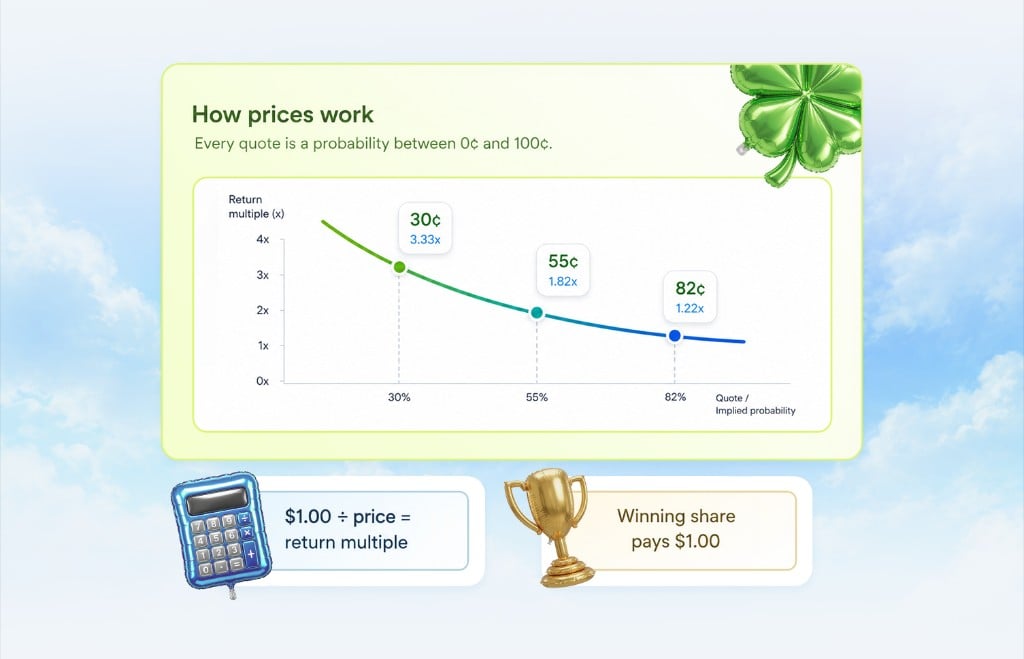
Return on investment (shown here as a multiple of what you put in if the contract resolves in your favor): each winning share pays $1.00, so the multiple is $1.00 ÷ (price per share). At 30¢, $1.00 ÷ $0.30 ≈ 3.33× on the capital you allocated to those shares. (Venue and platform fees are not included in this simplified example.)
If you buy 100 shares of Yes at 30¢, you pay $30. If Yes resolves true, you get $100. If Yes resolves false, you get $0. The same math applies to No.
KYC and onboarding
Pear does not run its own KYC desk. Identity checks happen only when you use services that legally require them, and only through our licensed partners:- Fiat onboarding: Depositing or moving fiat (for example card or bank onramp flows) uses MoonPay. You complete MoonPay’s KYC when their flow requires it. MoonPay is used by millions of people worldwide and is built for compliant fiat-to-crypto and related rails.
- Kalshi event contracts via dFlow: Trading those contracts uses dFlow Proof for the verification step dFlow requires. That flow is hosted and operated by dFlow, not Pear.
All Kalshi event contracts available through Pear are accessed via dFlow’s on-chain tokenized contracts; dFlow is the rail that represents and settles those event contracts on-chain.
Supported venues
Pear unifies every venue listed below into one trade flow. On most markets today, Pear routes the trade to the venue with the deepest liquidity for that market. Cross-venue price routing (the smart routing layer) is in beta and rolls out market by market.Polymarket
USDC-settled prediction markets on Polygon. Deepest liquidity for politics, crypto, and culture. Continuous orderbook, fast settlement.
Kalshi (via dFlow)
CFTC-regulated Kalshi event contracts reached through dFlow’s on-chain tokenized contracts. Verification for that path uses dFlow Proof when required; settlement and contract state follow dFlow’s on-chain design.
Pear also provisions a Solana wallet for your account (see Wallets & funding) so we can support Solana-native funding and future venue or settlement integrations without a migration. Today’s documented trading venues above are Polygon- and dFlow-centric, not an unlisted third “Solana markets” tab.
Settlement
Different venues settle differently. Pear normalizes everything to USD in your portfolio so you don’t have to think about it, but the underlying mechanics are:
When a position resolves, the proceeds land in the wallet on the corresponding chain. You can leave it there, swap it, or withdraw it.
Market discovery
Pear surfaces markets in three ways:1
Discover feed
Curated trending markets across every category. Updated continuously based on volume, recency, and relevance.
2
Search
Type a topic, candidate, ticker, team, or event name. Pear searches across every market on every venue and returns matches with current prices.
3
Followed activity
Markets that traders you follow have opened or closed positions in. The fastest way to find ideas you don’t already know about.
Keep reading: Overview · Trading · FAQ · Roadmap